
7 Stunning Libraries Around the World (Even Antarctica!)
For millennia, continents and cultures have maintained libraries. Here are seven uniquely interesting and inspiring ones — one on each continent — preserving knowledge, encouraging literacy, and sometimes staffed by bats.
14 September, 2026 ● Written by Stefan Bachmann
It makes sense that buildings built to house the stories and knowledge of humanity should be almost as beautiful and fascinating as their contents. What makes less sense is how contentious the very idea of a library currently is when governments sit down to discuss budgets.
Every week, somewhere in the world, a council votes for shorter opening hours, less funding, and closures. In England, more than 800 libraries have shut their doors since 2010. Roughly 9,000 library jobs have been lost. Staffing fell by 47 percent between 2010 and 2025, from just under 18,000 employees to around 9,500, while opening hours dropped by 22 percent. Unstaffed hours rose from 13,000 a year to more than 200,000, which means even where libraries are open, the trained professionals meant to guide people of all ages through information and literacy of all kinds are no longer there. In the United States, an executive order in March 2025 set out to dismantle the Institute of Museum and Library Services, the federal agency that funds state library programs; it took a court ruling and a settlement in April 2026 to keep the agency alive, and the budget proposed for the following year moved to cut it again. Worst of all, it’s small, low-income, and rural communities — the ones with the least local money to make up the loss of such institutions — that are always the first to suffer from funding cuts.
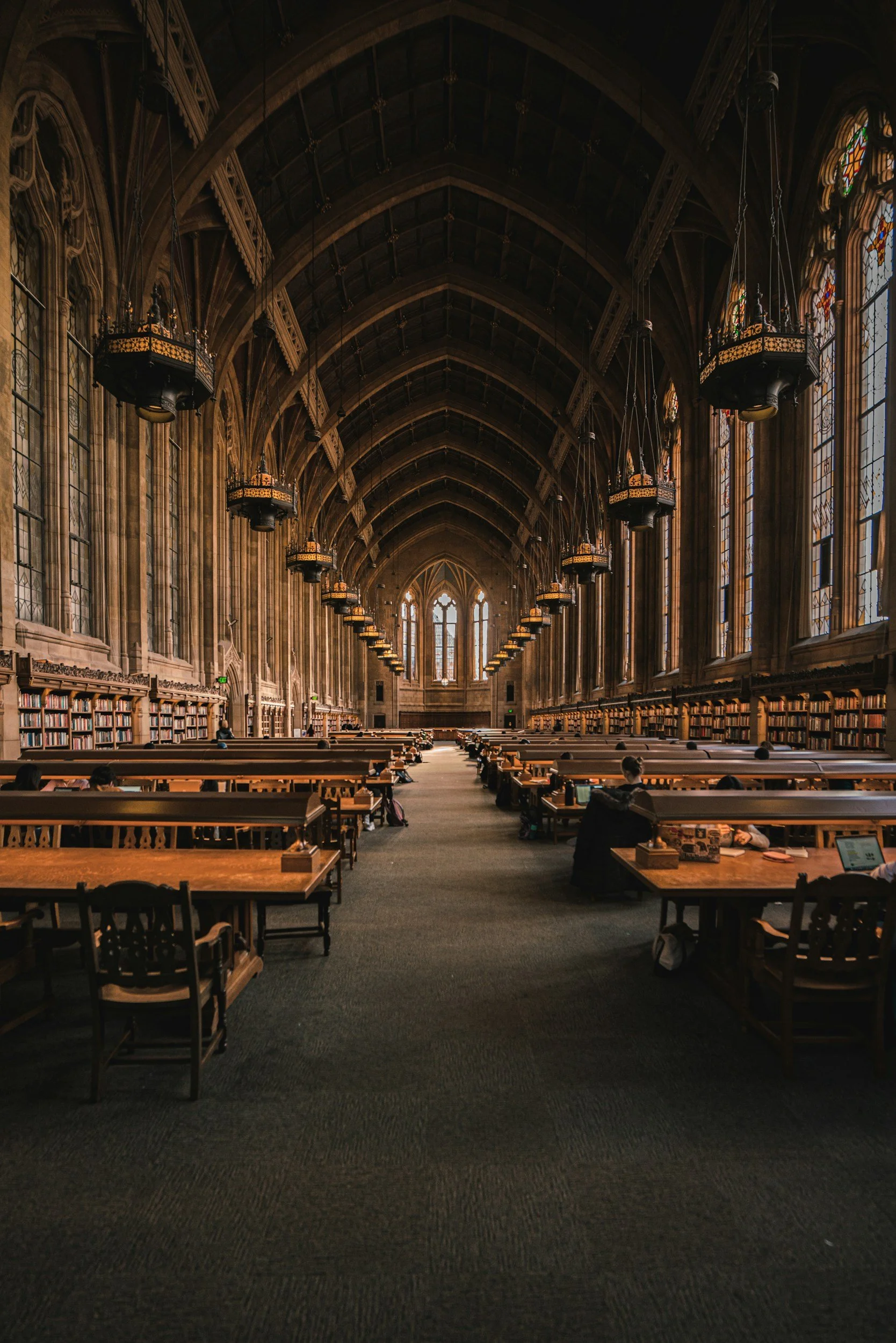
The problem, we think, is that the rewards of libraries are quiet and slow. Libraries do not make money in the traditional sense. They do cost money, and what they give back often only becomes visible years later, in a country’s literacy scores, in individuals’ confidence in handling and parsing information, and in the knowledge and abilities people carry into work and life. When you lay out plainly what a library is, it becomes somewhat more difficult to argue that it should not exist, prominently, at the center of every town and city.
Libraries are the repositories where literacy, information, and knowledge are held in trust for people: future people, people who cannot afford to buy them, and increasingly, people who could afford to buy them but would otherwise never encounter them. They are staffed by professionals who curate collections, teach information literacy, and run the story times that turn small children into readers. If these institutions are not available to people, where do they go? Is an internet full of brief AI summaries, particularly prone to misinformation, really a suitable replacement? Judging by a 2024 Stanford study finding that even legal research tools built on licensed case-law databases produced fabricated content in 17 to 33 percent of test queries, and a study of AI-generated medical writing found that 47 percent of its references did not exist at all, we think not.
And if you’re suspecting it’s only the large, expensive, public libraries that are affected: School libraries are vanishing, too, or simply sinking into obsolescence through understaffing and underfunding. Roughly one in five full-time school librarian positions in the United States was eliminated between 2010 and 2019, hitting the poorest districts hardest. At a time when literacy skills of all types are lessening, and children have been handed devices that produce fluent, confident, and occasionally invented answers on demand, this is just as sharp a loss as that of public libraries.
But at STORYVOR, we like to talk of hopeful things, and so if you’ve come this far, here is the bright side: great libraries filled with great information have existed for thousands of years, and are still being built by jurisdictions who recognize the importance of making them central to their cities and communities.
The seven buildings below, one from each continent, make the case for libraries in striking and unusual ways. From towering, modern monoliths, to dim, mysterious caves of books, each one illustrates the value and the dignity their societies placed on libraries, and their willingness to invest in literacy, learning, and knowledge.
Without further ado, seven wondrous libraries across the globe:
1. Biblioteca Joanina
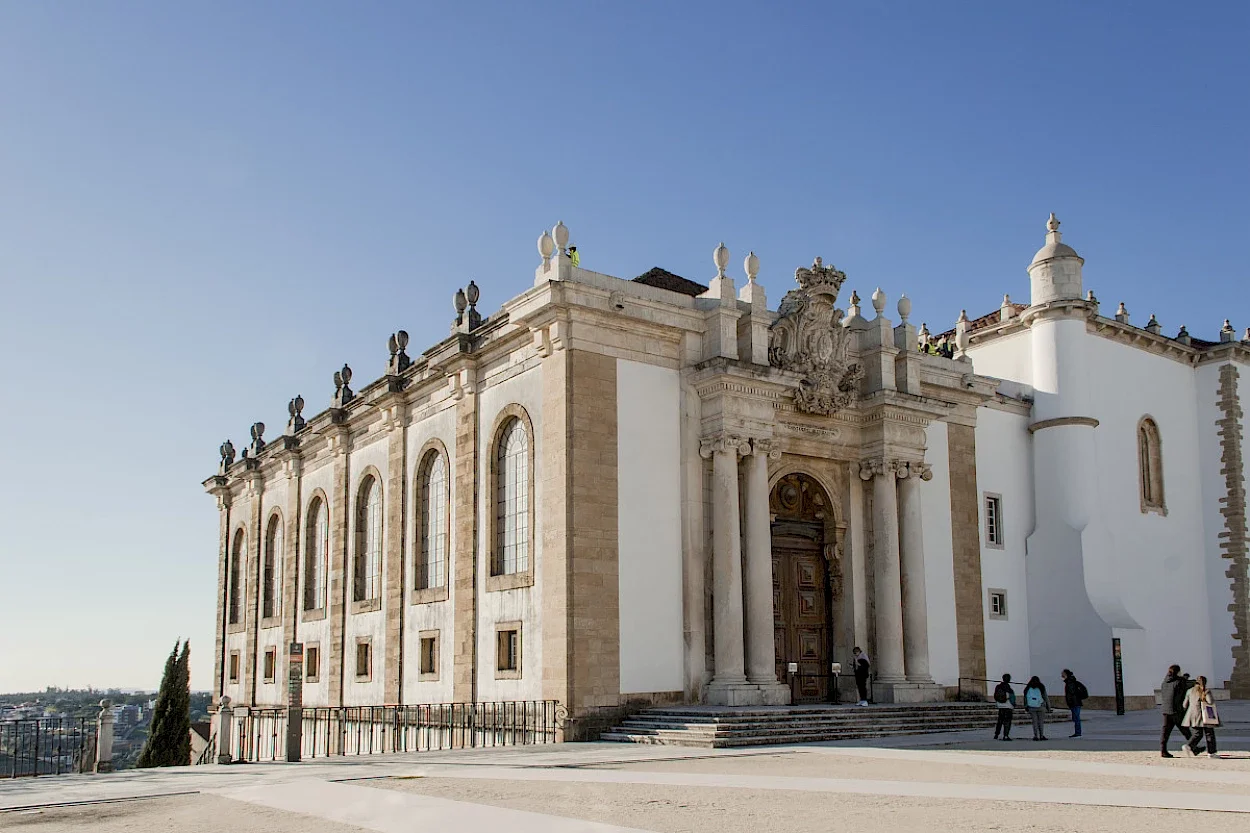
Image source
Coimbra, Portugal, completed 1728
King João V built this beautiful library as a statement that Portugal, and its university, belonged among the great intellectual powers of Europe. The decor is appropriately grand: Three halls open into each other through gilded arches. The shelves are painted with chinoiserie birds and pagodas. The wood is Brazilian rosewood, ebony and jacaranda. The main floor holds nearly 29,000 volumes, mostly law, theology, philosophy and medicine, with around 30,000 more on the working levels below. Among them are books and illuminated manuscripts taken from Portugal's convents and monasteries after the religious orders were dissolved in 1834. The outer walls are more than two meters thick, holding the temperature and humidity steady and preserving the centuries-old books inside.
The real curiosity is the “staff”. A small colony of bats has lived behind the bookcases since at least the nineteenth century, emerging at night to eat the moths and beetles that would otherwise chew through the manuscripts. Every evening the reading tables are covered with leather sheets, and every morning the covers are cleared and dusted. It is a three-hundred-year-old conservation method, and Portugal is the only country known to use it (the other bat library is at the Mafra Palace).
2. Real Gabinete Português de Leitura
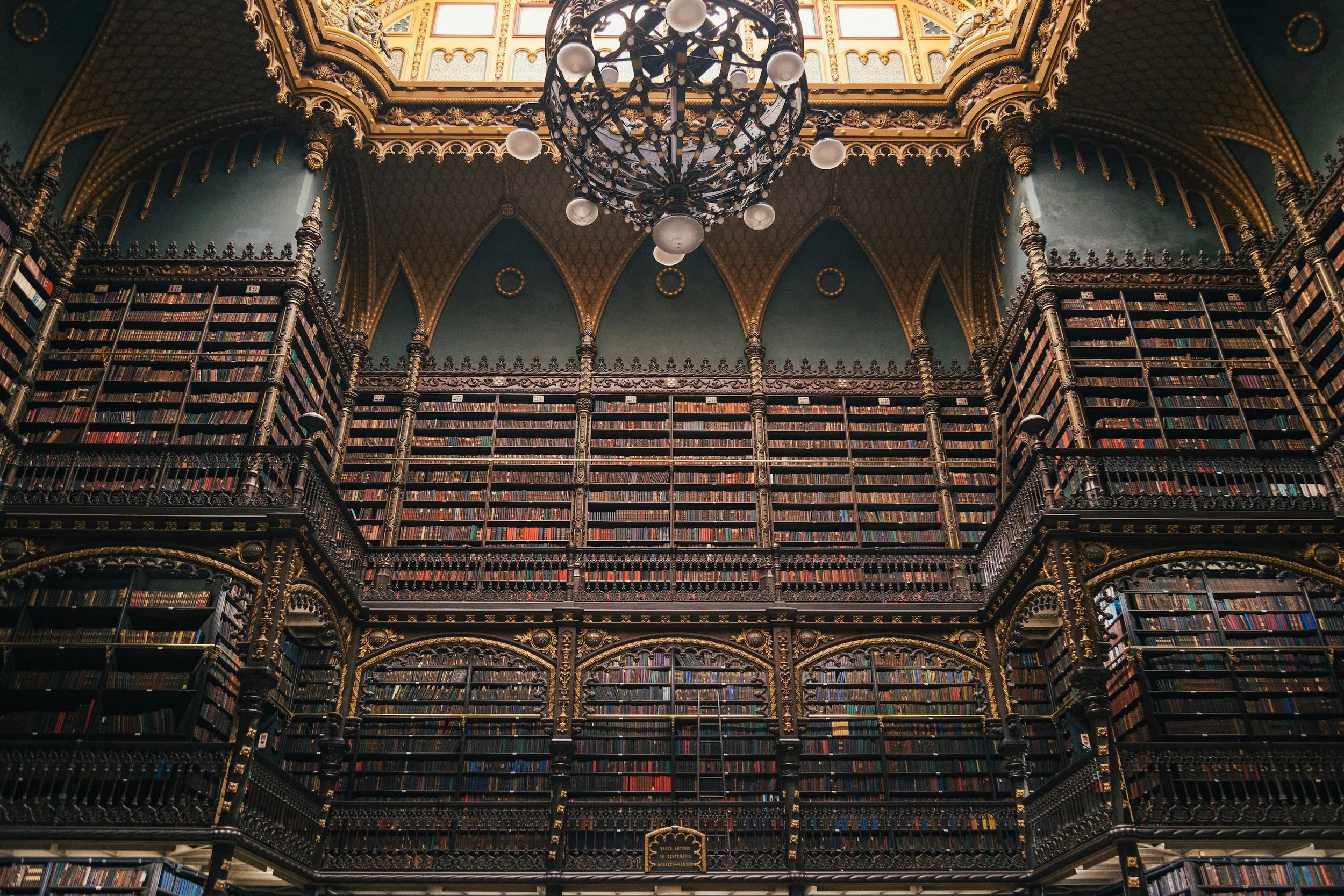
Photo by J. Balla Photography on Unsplash
Rio de Janeiro, Brazil, completed 1887
In the New World, in Brazil, is the counterpoint to the library in Portugal. . . .
Founded in 1837 by Portuguese immigrants who wanted their own books in their new imperial capital, the Real Gabinete moved into its current building fifty years later. The architect, Rafael da Silva e Castro, worked in the neo-Manueline style, a nineteenth-century revival of the exuberant Gothic-Renaissance architecture of the age of Portuguese exploration, and had the façade stone shipped from Lisbon.
Inside is like the interior of a jewel box, thousands of colored spines glimmering from the walls. Four storeys of dark wooden galleries rise towards an iron-framed stained-glass skylight, the first structure of its kind built in Brazil. The collection consists of roughly 350,000 volumes, the largest body of Portuguese-language works anywhere outside Portugal, including a first edition of Os Lusíadas from 1572, an epic poem about a fantastical voyage. The library has been open to the general public since 1900, it is free, and it sits in the middle of a noisy downtown district, which makes walking through the door feel like a startling moment of time travel.
3. Beinecke Rare Book and Manuscript Library
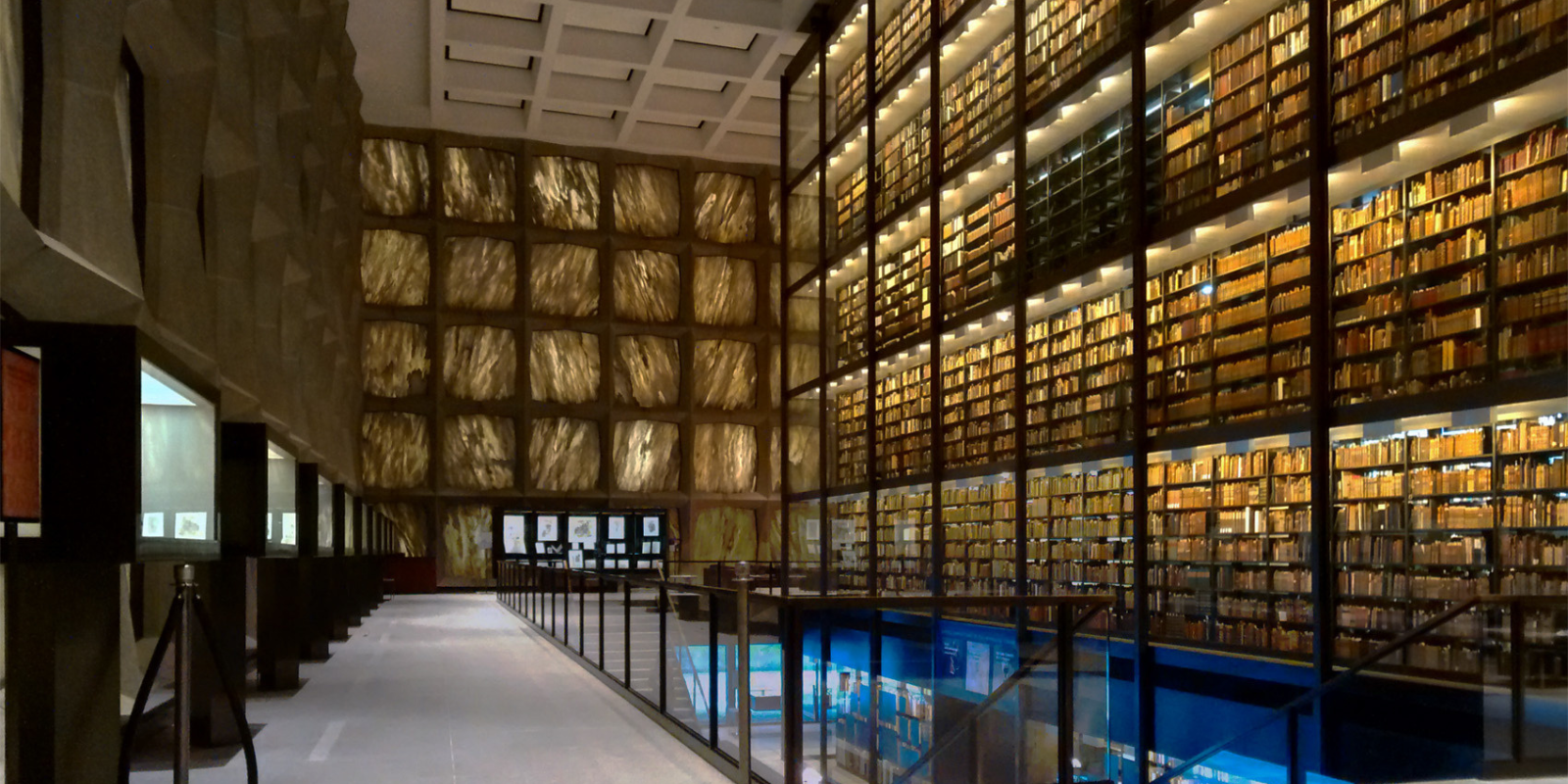
Image source
New Haven, United States, opened 1963
Gordon Bunshaft of Skidmore, Owings and Merrill built the books a windowless box of white Vermont marble, sliced to just over three centimetres and thin enough to be translucent, so that the only daylight reaching them arrives as a soft amber glow with the ultraviolet that destroys paper filtered out.
At the centre of the hall stands a six-storey glass tower holding about 180,000 rare volumes, climate-controlled and visible to everyone but accessible only to staff. More than a million more are stored below the plaza, along with the reading room where researchers actually work. A Gutenberg Bible and Audubon's Birds of America are on permanent display. In a decade when AI companies are buying up out-of-print books by the million, slicing off the spines and discarding the pages once they have been scanned, a building designed around the survival of the physical object becomes particularly precious.
4. Bibliotheca Alexandrina
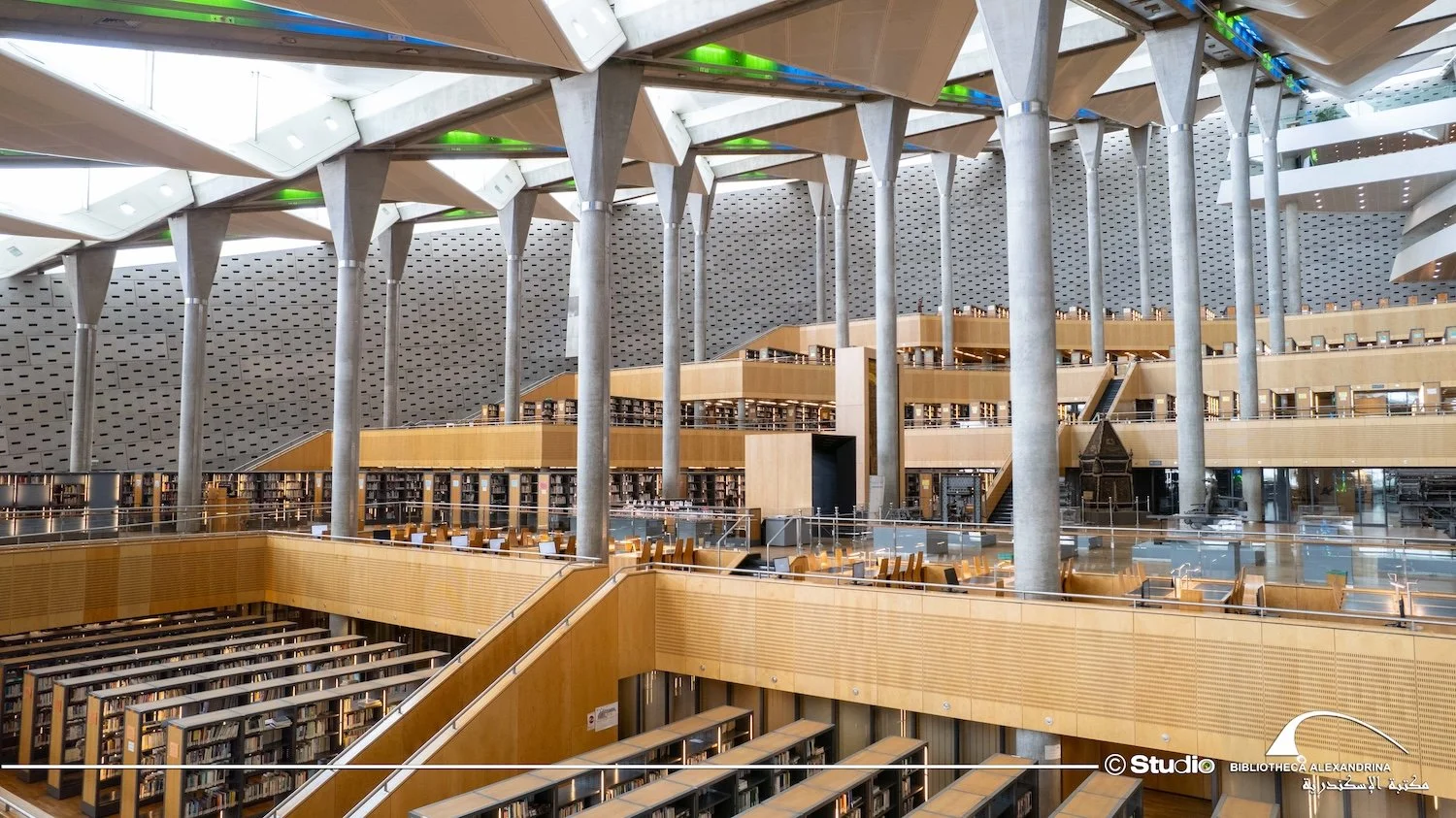
Image source
Alexandria, Egypt, opened 2002
Egypt and UNESCO set out to rebuild the most famous lost library in history for about 400 million of today’s dollars. The design that was chosen was a single granite disc 160 meters across, half sunk into the ground and tilted towards the Mediterranean, like a great coin. The Aswan granite of the outer wall is carved by hand with around 4,000 characters drawn from writing systems across human history, living and dead alphabets, mathematical and musical notation, even Braille.
Inside, the main reading room falls across seven terraces under a glass roof, seating roughly 2,000 people, lit from the north so that no book ever sits in direct sun. There is also a planetarium, several museums, and the Taha Hussein Library for blind and partially sighted readers.
5. Tianjin Binhai Library
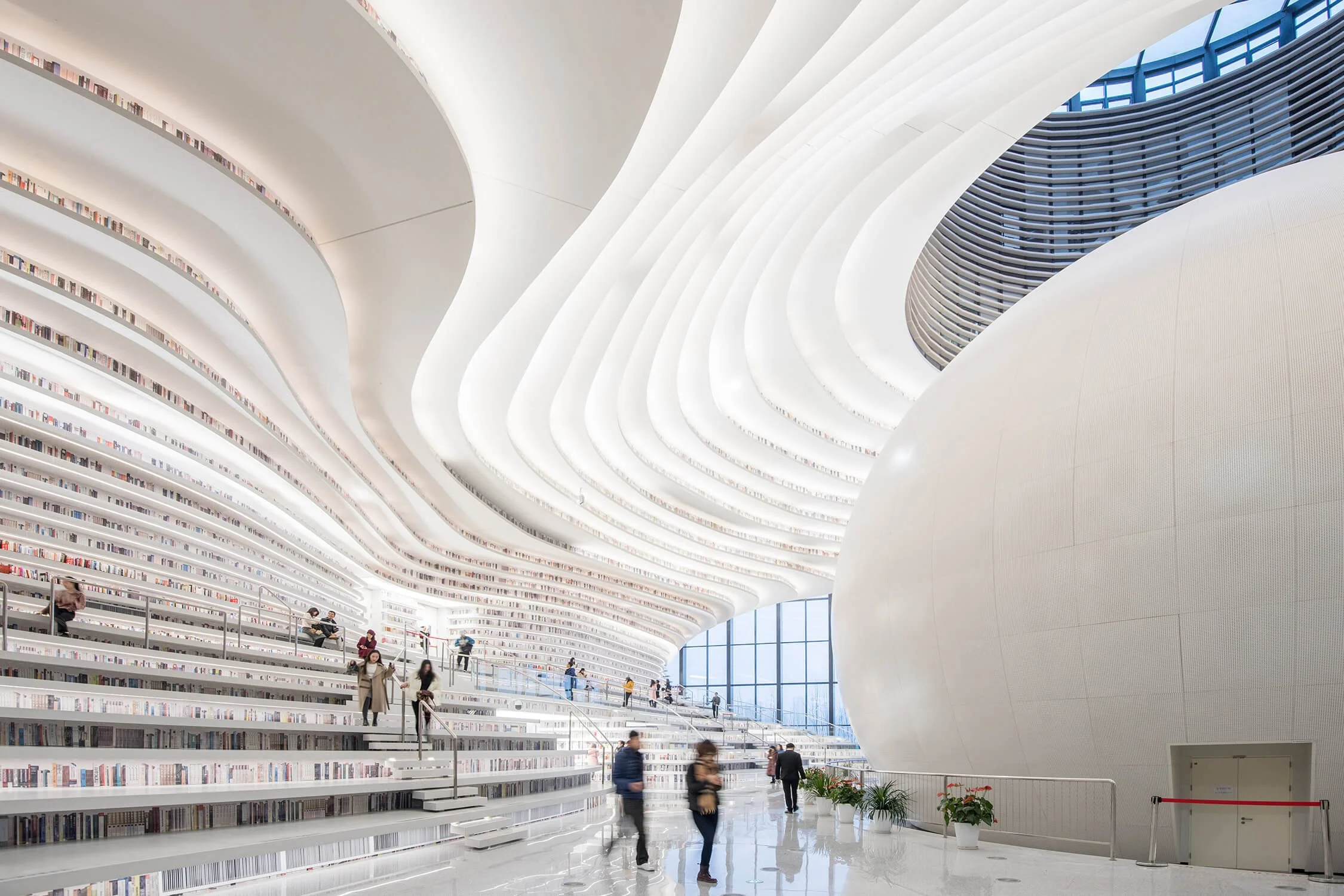
Image source
Tianjin, China, opened 2017
Is it the most practical library, with its occasionally unreachable shelves and thousands of printed aluminum spines? No. Is it a striking symbol of the importance of books and libraries all the same? Yes.
Tianjin's Binhai district built a cultural quarter from scratch and wanted a library at the centre of it. Though you might not guess it walking into this stunning building, they also wanted the library built fast: from first sketch to opening ceremony took three years. The result is a five-storey atrium in which terraced white shelves ripple from floor to ceiling like a topographical map, curving around a luminous spherical auditorium that seats 110 people. Seen from the park outside the whole thing reads as an enormous eye, and the nickname stuck immediately: the Eye of Binhai.
It also became the most argued-about library of the last decade. The original design called for access rooms behind the atrium so readers could reach the upper shelves. That element was cut locally during the rushed construction, against the architects' advice. The upper shelves are therefore lined with perforated aluminum panels printed with images of book spines, and the real collection sits in conventional reading rooms elsewhere in the building. A printed wall of spines might be a poor substitute for the real thing, and cutting the access rooms is sad, but the real books are there in the hundreds of thousands and the symbolism stands strong. The city chose to put reading at the centre of a new district, in a spectacular, unmissable way.
6. Mortlock Wing, State Library of South Australia
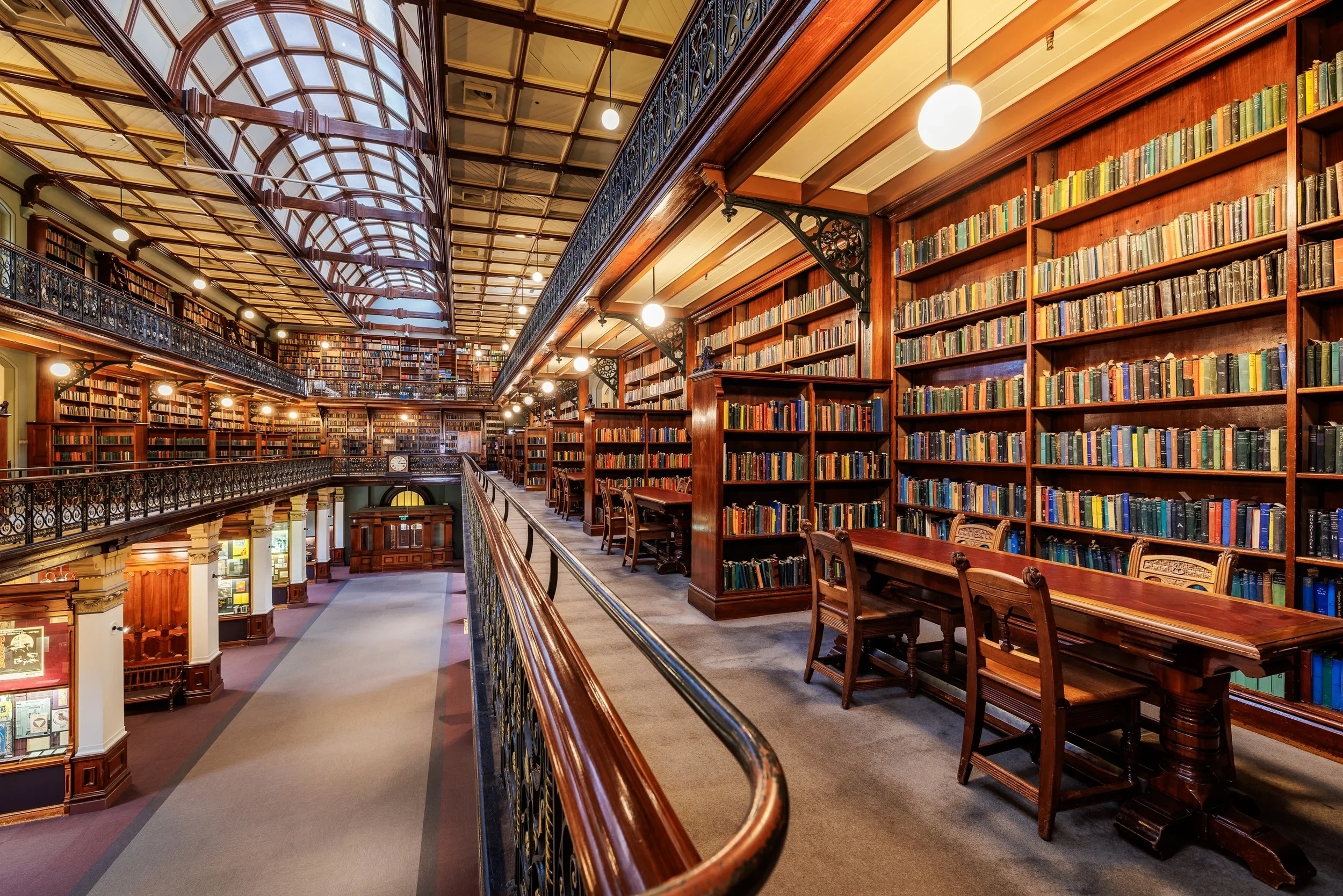
Image source
Adelaide, Australia, opened 1884
A colony not yet fifty years old decided it needed a public library, a museum, and an art gallery in one building. After many setbacks, it opened in December 1884 with a staff of three and 23,000 books, 12,000 of them chosen for their "sterling merit" from the old Institute library and 11,000 bought new, sharing the room with articulated skeletons, minerals, shells, insects, and the pictures that would become the state art gallery.
At the time, the board was so pleased with the finished chamber that they decided it needed a clock. One was brought in London in 1885 from Dent & Sons, the firm behind the clock at Westminster. It cost £50, a small fortune, because it was fitted with a mechanism that reset its hands every hour by telegraph signal.
Today, two tiers of galleries run the length of a single chamber, the lower on masonry columns, the upper on cast-iron brackets, balustrades picked out in gold, and above it all a glass-domed lantern roof. The library reopened after renovation in October 2025, and was recently ranked the second most beautiful library in the world.
7. Library in the Ice
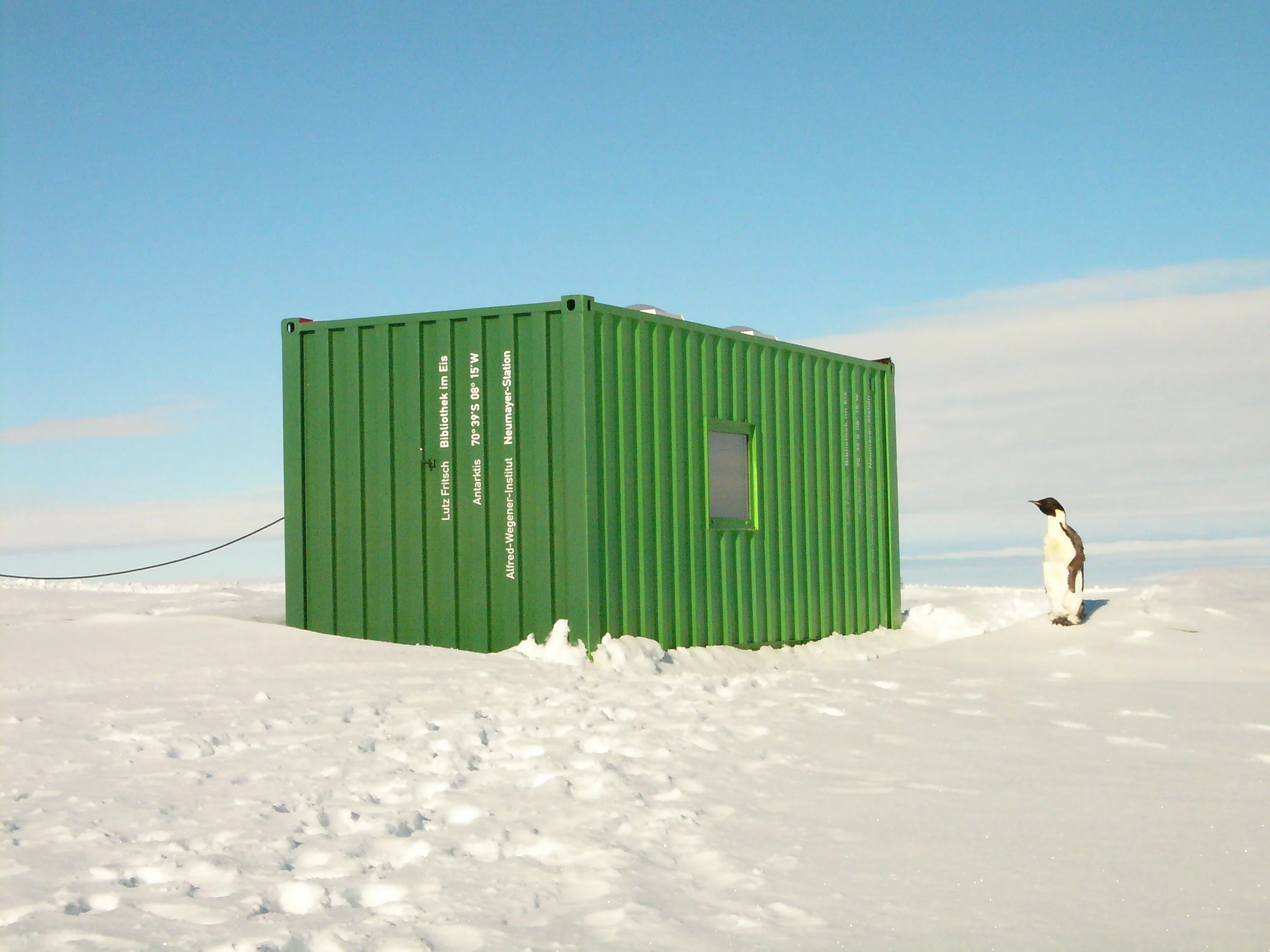
Image source
Ekström Ice Shelf, Antarctica, installed 2005
At 70°40' south and 8°16' west, a few hundred meters from Germany's Neumayer Station III, there is a twenty-foot shipping container painted green, with a red roof and floor. Inside are cherry-wood shelves, a table, a lamp and a leather sofa.
The Cologne artist Lutz Fritsch first travelled to Antarctica with the Alfred Wegener Institute in 1994 and noticed two things: how much the scientists wanted to talk about art, and how relentlessly functional the station itself was. The container was built with the institute's support, shipped south on the research vessel Polarstern, and opened in January 2005. When the old station was replaced, the library moved with it in 2009.
Lutz Fritsch chose green for the library deliberately. The ice is white, sometimes grey, sometimes blue, and the polar suits are red, so green is the one color the overwintering crews never see. The shelves hold roughly 700 books, each one donated by an invited artist, writer, musician, or scientist and inscribed with a personal dedication. The station leader of each overwintering team automatically becomes the librarian. Only the artist and the people who have actually wintered there know which books are on the shelves, a secrecy that is part of the work and is meant to stay that way. The library becomes a sanctuary in a desolate landscape.
Fund Libraries, Everywhere
Libraries are often considered a cultural extra, competing with theaters, concerts, sports, and leisure activities for whatever is left over. However, it bears repeating that they are infrastructure, in the same category as a school or a courthouse: places where a public good is held and made available to everyone regardless of what they can pay.
The magnificence of many of the buildings above is not waste, either, though it should always come second to the funding of staff and collections. Still, architecture is how a society expresses what it finds important. We build beautifully for luxury hotels, for courthouses, for corporate headquarters. Should the spaces in which we keep our literacy, knowledge, stories, past and future be relegated to mouldering, unstaffed rooms? Make them grand, we say. Make reading visible, huge, and wonderful, exactly as it deserves to be. This visibility is needed now more than ever.
Want to find more beautiful libraries anywhere in the world? Visit 1000 Libraries here.

Stefan Bachmann
Editorial Director
Stefan Bachmann has worked widely in education, cultural programming, and literacy advocacy for over fifteen years. He is an internationally bestselling author of children’s books, co-founder of Foundations in Literacy, co-president of AUTILLUS, the Swiss Association of Children’s Book Authors and Illustrators, as well as a member of various advisory boards and committees in Switzerland and abroad. He studied composition and theory at the Zürich University of Arts.

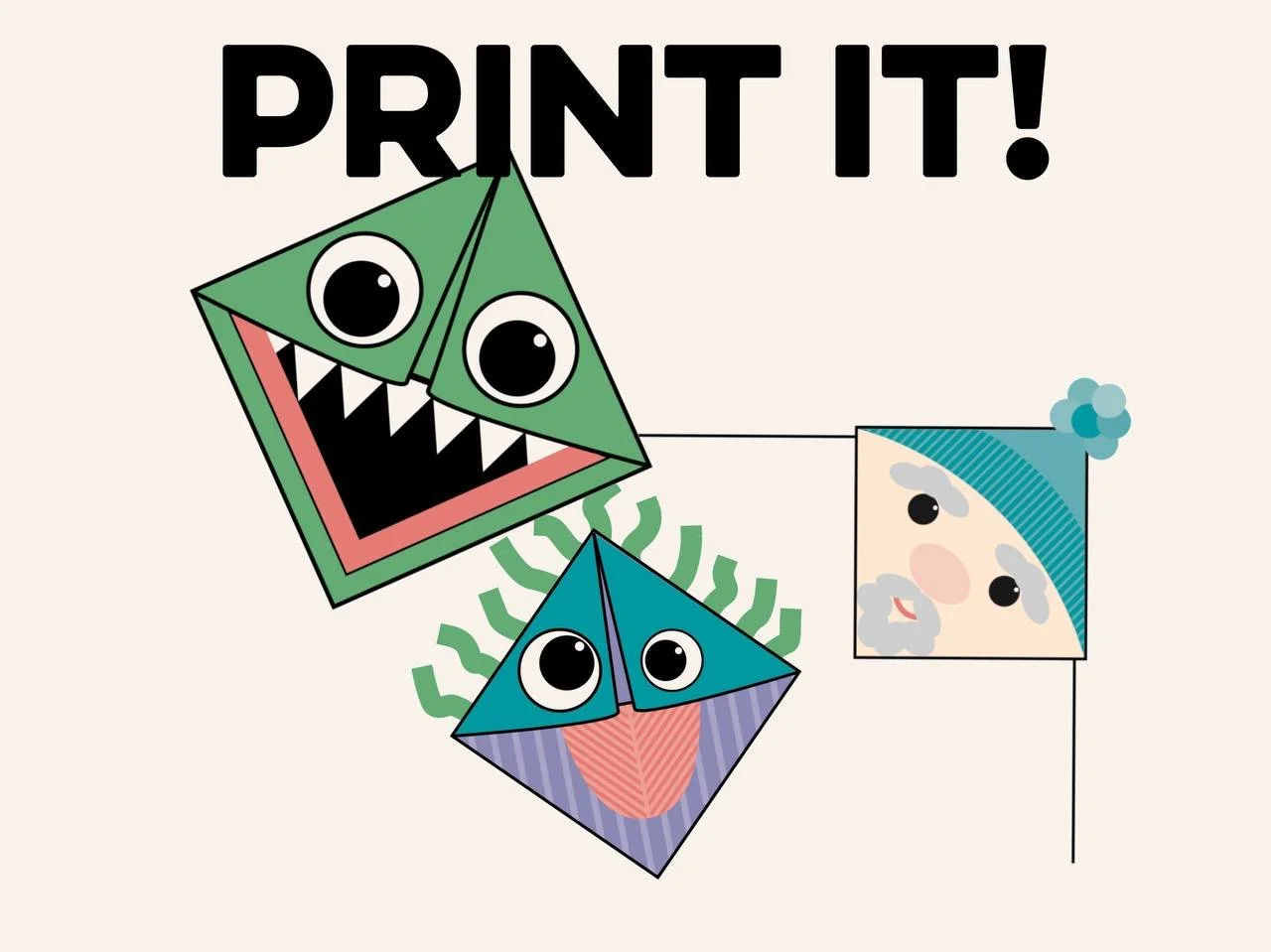
Sarah Y.'s illustrated, printable play-set turns a few sheets of paper into a castle, a river, a dragon, and a story. Use it in class for crafting time, storytime, and world-building.